
Do you really run every single day?
I currently run 4 miles every single day. I never take a day off, no matter what. I've been doing this for over 500 days now, and I plan to go for another four years total. Before this, I ran 5 kilometers (3.1 miles) every single day without breaks for three years straight from June of 2020 to June of 2023.
These streaks have had a remarkably positive impact on my life. Of course it’s improved my fitness, but it’s touched many other areas of my life as well. It helps me get better sleep, it gives me time to think, it improves my mood, and it’s a source of meaning and purpose. It has become integral to my very identity.
The best part is it’s all automatic - I hardly think about it anymore. I will run 4 miles every single day, no matter what, and it’s not even hard.
I don’t think any of this is due to traits unique to me, I think anyone who attempts to run every single day will see similar effects. I also think pretty much anyone can run every single day. I'm putting this out there as a resource to help others follow in my footsteps with their own running streaks.
What if I’m not in shape or don’t have much experience running?
If you're thinking this, I think you're the kind of person who can benefit from this the most. But I agree that if you can't run a 5k at all, starting with 5k every day doesn't make sense for you. Almost everyone can walk a mile though. So, if you're starting from the bottom, I think the minimum goal you should have is to "run" 1 mile a day for a whole year.
Do not focus on speed, especially at first. In my 5k streak, there were many days I had to walk the whole distance due to injuries, sickness, or eating 3 bowls of cereal at 10PM when I had not run yet. You should try to jog as much as you can, but there's nothing wrong with walking as much as you need to to cover the distance.
My average pace was probably a bit faster than 9 minutes per mile in my first streak. All that matters is covering the distance. No one worth listening to is going to interrogate you and say your streak "doesn't count" if you need to walk.
Why do it every single day?
The main reason to go every single day is behavioral. You're much more likely to actually run if not running means giving up on your progress towards your streak. If you choose the right distance from the outset and know your limits, you won’t need to take a break - I promise.
For most people, sticking to an exercise routine is very hard. I believe that's because it's extremely hard to manage days off. One unplanned day off leads to needing to do extra work to make up for it, which often can't be built back up in just another day. The interest on missed activities piles up until the entire habit collapses. The slow rotting away of your routine is demoralizing and leads to being less likely to try again in the future.
With a streak, its simple: we don't need to worry about rest days if we never take them. The end of any exercise routine begins with a day off, so not taking days off necessarily means your exercise routine will be indefinitely maintained.
You'll quickly start to take pride in your streak and getting to contribute to it each day will be exciting, further increasing the odds it'll become a lifetime habit.
It's way easier to say, "Sorry, I'll have to show up to the party an hour late since I have to get my daily run in." or you won't care if it's raining out or you feel sick or if you've been traveling all day. You don't need to draw from motivation or willpower, your running is something you do every day without thinking because you need to do it. It will become part of who you are.
Is it safe to run every single day?
It’s true that it’s possible to injure yourself running, but you can mitigate your risks a lot and the health benefits will massively outweigh any potential risks. I’m not a doctor, but I’ve spoken with doctors about my streaks and none of them have told me to stop yet. There are tons of people who run way more than me too and manage to do it without getting injured.
Here’s what you should do in order of importance to prevent injury:
- Get enough sleep (7 - 8 hours per day)
- Wear shoes and socks that fit you when you run
- Pace yourself, take it easy most days and especially on days when you’re feeling sore
- Keep your feet straight when you plant them on the ground (avoid overpronation)
- Find safe routes to run (avoid traffic, hard surfaces, and unmaintained wilderness)
- Make sure you’re drinking enough water and eating healthy
- If you stretch, make sure you’re doing active stretches before you run (stretches where you’re moving) and not static stretches (stretches where you hold still in a position)
- Replace your running shoes once they’re worn out. (There is conflicting info out there on exactly when you should do this, I get a new pair around every 5 months or so but keep two pairs in use that I rotate between daily)
How much time will this take?
Doctors recommend getting an absolute minimum of 150 minutes a week of moderate intensity aerobic (aka cardio) exercise a week, or half as much if your activity is higher intensity. However, that's the bare minimum to stop your body from rotting away. Plus, it’s not like any activity past that amount has no benefit. In my experience, going beyond that is where the real benefits start. There’s evidence showing you see better outcomes going up to 6 hours of cardio a week, so this is worth making some sacrifices for.
Let’s dig into the numbers a bit of how much time you’ll be spending a week on this though. If you’re not used to running or will need to walk a lot at the start, you’re probably looking at 12-20 minutes per mile you do per day. If you’re in okay shape, a good rule of thumb is 10 minutes per mile. You'll be able to complete your runs faster over time too.
If you’re new to running, stick to either 1 or 2 miles per day. If you have some experience, I think it’s fine to start with 3 miles or 5k. If you’re a very experienced runner you probably don’t need me to tell you what to do, but I personally don't think I'll attempt a running streak more than 10k a day so you can use that as an upper bound if you want.
When I was running 5k every day, most days I'd be completing my runs in around 25 minutes. On my fastest days I'd be getting it done under 20 minutes, and at my slowest I'd just walk the distance in 45-60 minutes.
Why running and not a different activity?
Running is the most accessible form of exercise by far. You technically don't need any equipment and everyone knows how to it.
…the only place I'd really recommend running without shoes is the beach though. Fortunately shoes are cheap as far as exercise equipment goes. My personal shoes of choice are Hoka Clifton 10s/Nike Pegaus Premiums, but basically any sneakers are fine to use as long as they're in good condition.
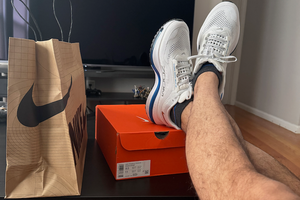
If you really love biking, or swimming, or rowing that's great - I'm not here to hate on them! I think they're equally effective forms of exercise and you're probably less likely to get stress injuries doing those activities. However, if you currently have no allegiance to an activity and could pick only one, running is the clear choice. It's the easiest to get into and easiest to maintain a streak for.
An entry level bike is going to cost you much more than entry level running shoes, probably around 6x - 8x more. It's possible that in the very long term biking evens out in terms of pure financial cost, but for most people it probably doesn't. Rowing is like biking but even more extreme, but maybe if you already have a gym membership it could work out well financially. If you happen to live right next to a public pool, that could be very cost effective, but that's not most people. Plus you’re at the whims of the your pool's hours.
If you ever have to leave your house and travel somewhere else overnight, good luck taking your rowing machine or pool with you though. If you're a serious biker maybe you could make it work, but probably not if you're flying. With running you're brining your shoes with you by default.
On the days when you've pushed your exercise until the end of the day and you don't really feel like doing it and it’s raining like crazy outside, having the least resistance possible can be the difference between extending your streak or letting it die. With running, all you have to do is lace up your shoes and step outside.
(Please try and check the weather ahead of time and plan around it though)
What about weight lifting? Can't I just do that or won't running hurt my gains?
Disclaimer, I'm not an expert on this. Strength training is good for you and you should be doing both it and running. With that said, if you're just getting started and currently do neither, I think you should start with a running habit.
There are health benefits from strength training, but in my opinion the health benefits from cardio are more substantial. Cardio improves your heart and circulatory system - which is probably more deficient for most people in developed countries compared to muscle mass. There's also the previously mentioned benefit of not needing to take equipment with you everywhere to maintain your running habit. I know there are big gym chains with branches all over that make keeping up a strength routine less bad than non-running cardio though.
If you're already super serious about strength training and are worried about running effecting your gains, I have seen some evidence out there that it can have a mild effect of making it harder to build muscle. However, that's mostly for people who take running super seriously. If you keep your running intensity down and aren't running crazy distances, the effect on your ability to build muscle will be pretty minimal as far as I understand it.
Where and when should I be running?
I don't have a preferred time of day. Sometimes I run first thing in the morning, sometimes I run just before lunch, sometimes I run with just enough time to get it done before midnight hits (I don't recommend that and rarely need to anymore.) Running every day gets me in the habit of checking ahead for the weather so I can run when it'll be most comfortable, but sometimes my schedule says I have to run at a particular time and I make it work.
As for where to run, my key recommendation is to run somewhere with the least amount of traffic possible. If you have access to a treadmill, that's great - I love treadmill running. You have perfect control of the speed and incline, you can run in a climate controlled room, and you can watch something while you do it.
But sometimes you don't have access to a treadmill and running outside just feels nice. I run outside most of the time.
When outside, I'd avoid trying to drive anywhere to run if at all possible. You want to be able to go from having the idea to run to actually running as quickly as possible, especially in the first few days of your streak. Figure out a route that takes you to a place with minimal traffic. Parks and well maintained trails are ideal. If you need to run on the road, make sure you run facing traffic in areas where you have plenty of visibility around corners or hills and you have enough of a shoulder that you can move aside if cars are coming.
In terms of running surface, here's what I'd recommend to be easiest on your legs Running Track > Maintained Grass > Treadmill > Dirt > Gravel > Sand > Asphalt > Concrete > Unmaintained field (tripping hazard)
I personally love finding the optimal route in an area that has the minimal car traffic and best ground conditions and running that route every single day, but I think for most people it's fun to explore around try many different routes.
Should I be tracking my running?
Absolutely. I think tracking is key to really forming the habit. Fortunately, it's easy to do. I love Garmin watches (I currently use a Garmin Forerunner 255 w/ Music), but I think basically any fitness or smart watch will be able to track enough to get started (here are some Wirecutter recommendations). If you don't have a smart/fitness watch, I'd recommend just using Strava on your phone. It's free and works perfectly well plus it has social features which could help keep you motivated if you have other friends who can cheer on your runs. Of course, there's nothing wrong with manual tracking in a excel spreadsheet or even good old pen and paper. I'd give a slight edge to digital solutions because they make the tracking as automatic as possible though.
I did track my first month of my 5k steak with a excel spreadsheet, but then I got a Garmin Forerunner 55 and had it sync all the activities to Strava.
If you're using a Garmin watch but run on a treadmill, be sure to select the treadmill activity type then at the end of every activity scroll down to the "Calibrate Distance Option" and just put in what the treadmill says, it will be more accurate than the watch.
What other running gear do I need?
Shoes are the only thing I wouldn't go without, and an entry level tracking watch is the next thing I'd get.
I'm not picky about my running clothes. I just use general athletic socks, shirts and shorts. If I'm running somewhere with a colder climate I sometimes wear gloves, running tights or a windbreaker.
I love my Airpods Pro, but they don't stay in my ears when I run so I bought different running earbuds. For a few years I used bone conduction headphones - but just generic ones on Amazon for like $100. Their auto quality isn't the best, but you can hear your surroundings which is nice for safety when running outside. They're also extremely water resistant and I had no problems even just wearing them going into the shower after my runs, but both pairs I bought broke about a year after I bought them.
Nowadays I use Beats Fit Pros. Their audio quality is much better than bone conduction ones - they're basically the same as my Airpods Pro and they have all the nice Apple auto pairing/device switching features. Their noise cancellation mode makes them a much better choice on the treadmill, and if I'm running somewhere outside where I'd like to hear their transparency mode is top class. They're sweat resistant enough that I don't worry about them unless it's really raining, but I don't take them in the shower with me.
I recommend against big over ear headphones when running, but other than that different people have different preferences for this stuff so try and figure out what works best for you.
What exactly do you mean when you say ‘every day’?
For me, running every day and maintaining my streak means having a run logged in Strava for each calendar day that starts and ends during that day for the time zone I’m in when I do the run. This can be a little tricky when I’m flying against time zones, (I’ve had to rush out of a plane and run around the airport parking lot before) but this matches the best with how Strava calculates what day runs belong to and feels the most intuitive to me.
For my 5k streak, I allowed myself to split up my activities to an extent, such as running to class and listening to the lecture for an hour then running back to my apartment. With my new streak I’m enforcing only allowing for brief pauses in activities to wait for traffic lights or stuff like that, just because it feels more complete in my head that way.
I need to cover the full distance according to my Garmin watch or the treadmill I’m running on, but the speed doesn’t matter to me. Even if I need to walk most or all of the distance, I still count it as running every day. To some, it may sound like I’m stretching my definitions a bit. That's fine with me. The only thing that counts is whether you think your streak counts, but you have to be honest with yourself about what your rules are when you start. I suggest writing them down so you can go back and reference them.
You don’t have to follow my exact parameters, give yourself a speed minimum if you want to. Make your required distance way shorter or longer. Allow yourself to record a second consecutive run in a day to make up for a plane flight the next day, or go based on whatever time zone you want instead of the time zone you’re in. Your rules can be whatever you want, think through what works best for you.
I won’t argue with anyone about whether or not their streak counts, however, it’s important to keep in mind the whole reason for framing your activity around a streak in the first place. Allowing rest days, or setting a weekly distance quota instead of daily is a slippery slope that can lead your whole system to collapse.
How can I make sure I don’t miss any days in my streak?
As long as you set an appropriate goal and get invested in maintaining your streak, it’s actually way easier than you might expect to keep your streak going.
When I stopped running after 3 years of running 5k every day, it wasn't on accident. I stopped after 3 years intentionally after planning it out months ahead of time.
I actually think having a planned stop date for your streak is very useful. If your goal is to "run 2 miles every day for the rest of my life", you will fail your goal eventually. And if you know you’re going to fail at some point, failing on any given day feels much more acceptable to you.
If you’re like me, you’ll neurotically wake up at 11PM and double check that you actually put in your run for the day (I only felt this for the first 15 months or so). For maybe more normal people, it might make sense to set up reminders on your phone or ask some friends to keep you accountable. Once you’re over the 1 month hump I think you’ll be surprised that it’s easier than you expected though. I truly think nearly anyone can do a 1 mile per day 1 year streak.
What do I do if I miss a day?
If you fail on accident, start your streak again. Take it as an opportunity to adjust your distance minimums or goal length if you had to take a break because things became too difficult. However, you’re probably much less likely to miss a day on accident than you think you will be.
What do I do after I complete my streak goal? Should I just keep it going as long as I can? Or maybe start on another harder streak goal?
After I was done with my 3 year 5k streak, I took a year to reflect on it and just ran when I felt like it. I trained up and ran a marathon, which I didn’t originally feel like I could safely do in the middle of my 5k streak. Without the guardrails of my streak I slacked on my training and did poorly though. Then after thinking about it a lot, I decided I really missed the structure of the streak. I feel way better now that I’m on a streak again. Despite increasing my distance, it feels even easier to me than the original one did. I feel better day to day, I sleep better, and I take a lot of pride in my new journey.
I do think it’s important to take at least a bit of time to stop running every day and reflect. I think you’ll come to a similar conclusion to me and eventually feel the itch to get back into it, but maybe you’ll find a routine that works even better for you. No matter what you end up doing, you’ll always know for the rest of your life that you are capable of running every single day. You’ll be able to get back to it when the time feels right, just like I did.
Anything else?
I could write about this forever, but you now know everything you need to get started! If you’ve made it this far you’re at least a bit curious, so just go get started today! You can’t start building the streak without completing the first day, and you can figure out the fine details later. Once you’ve completed at least day one, feel free to ask me any questions that come up along the way.
Good luck, and I hope you see all the same benefits I did.